
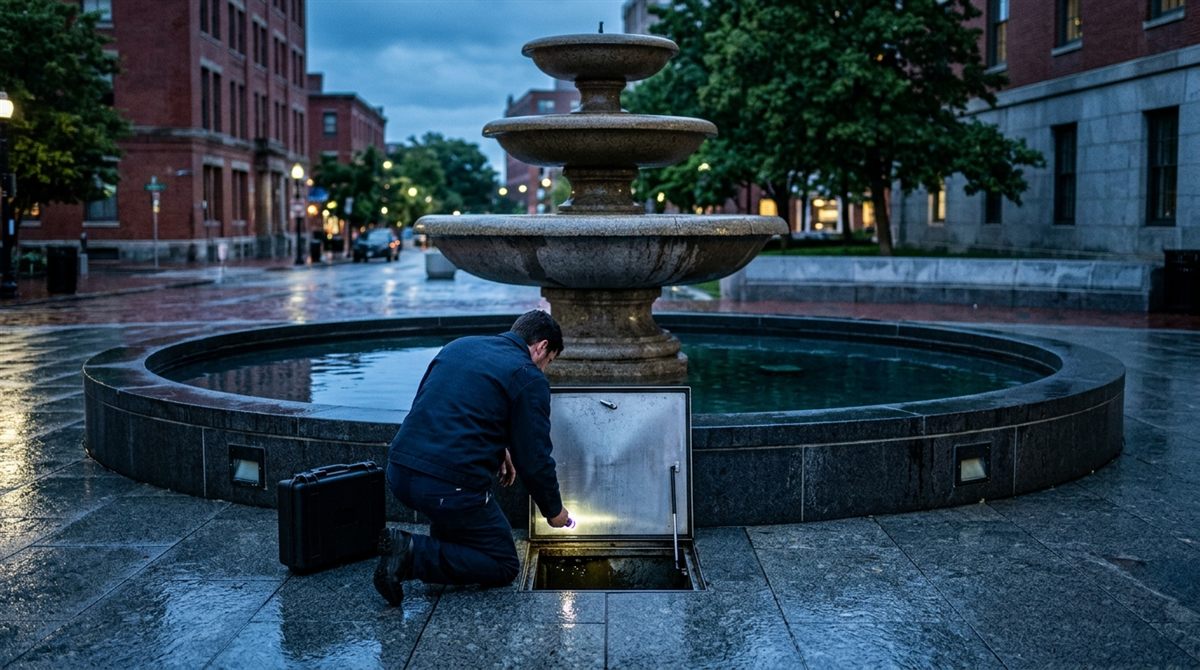

After a weekend of heavy rain, a city plaza fountain's jets and basin lights go dark, and the city's contact emails a photo. The fountain service company's technician has it running again within days, but the city pays the $1,854 repair invoice only when the evidence of the work arrives with it.
The trouble starts with something anyone crossing the plaza can see. The jets have stopped, the four basin lights are dark, and the city’s contact has already emailed a photo. A weekend of heavy rain points to water in the lighting circuit. So the question is what your technician puts on the fountain service report so that the city pays for the repair when the invoice arrives.
A repair is paid on evidence, not on the technician’s word, and each buyer writes into its own contract which evidence it wants, so that is where the record starts. In this example the fountain belongs to a city in the United States, and that city’s fountain maintenance contract sets the terms. A fountain somewhere else is paid under its own buyer’s terms, which may ask for other evidence. The contract terms quoted here are real, but the fountain, the callout and its record are an example built for this guide.
The short answer: Before you send a repair invoice, read what your client’s contract says must come with it, because that is what gets it paid. Send a written estimate and get the client’s written approval before the chargeable work starts, and keep the approval email with the callout. Record what the technician found, what was done, the parts and the hours, the restart test, the before and after photos, the date the repair was finished and the cause of the fault, and send that record with the invoice. Some clients check something else, such as a tag the technician signs and leaves at the fountain, so follow what your own contract names. This week, read the repair and payment clauses in your biggest contract and list what they ask you to send.
Where the fountain service report starts: the city’s contract terms
The city set out its terms in its Invitation to Bid 51642, “Seasonal Maintenance of City Fountains”. The city’s Board of Contract and Supply issued it for its Public Works department, and bids opened on December 29, 2025. The contract runs from July 1, 2026, to June 30, 2027, and covers three of the city’s fountains. Because it is one city’s request for bids, it sets out what that city asks of the company it hires, and it is not a state law or a rule for every contract.
Its section on contingency repairs lists the faults a callout covers, from pump failure to weather damage and lighting. Then it sets five conditions that shape the record:
- every repair “must be pre-approved in writing by the City’s designated contact before work begins”;
- your company provides “a written estimate of labor and materials”;
- the work is billed on time and materials, at the rates in your price proposal;
- the city may “seek alternate quotes for major repairs exceeding $5,000”;
- the one-year warranty on labor, materials and parts “begins on the date of completion of the applicable service or repair”.
The city’s standard terms add the payment rule. Invoices “shall not be processed for payment” without “reasonably sufficient support documentation”, and until that documentation arrives, the city’s 60 days to pay do not start. In other words, the record is what backs the invoice, not an extra.
The $5,000 line is not a cap, either. Above it, the city may ask other companies to quote for the repair, so your estimate can become one quote among several. The bid notice also says that no work starts without a purchase order, so the purchase order number belongs on every document.
The estimate and the city’s approval come before the repair
On site, the technician first makes the fountain safe. That means isolating the faulty circuit, taping off the area and taking photos before anything else. The city’s terms do not say whether that first visit to assess the fault can be billed, so settle that with the city before the first callout.
The repair itself waits for approval. Your estimate shows the hours at the standard or after-hours rate, each part with its price, and the markup on materials, which are the lines on the city’s price form. When the city’s contact answers by email, keep that email with the callout, with the sender’s name and the date, because an approval dated after the work is a gap the city will see.
A fountain service report filled in for one repair callout
Here is that callout from the first email to the invoice, under terms like this city’s. The fountain, the dates, the rates and the prices are the example’s own, and only the contract terms are real. The company keeps the whole record digitally, filed under the fountain it belongs to.
| Line of the report | Entry (example) |
|---|---|
| Water feature | City plaza fountain: three-tier cast stone, pump vault, four LED niche lights |
| Reported, Mon Aug 10, 2026 | 8:05 a.m. email from the city’s contact: jets off, lights dark; asks for an assessment |
| What the technician found, Aug 10 | On site 10:20 a.m. The ground-fault breaker (GFCI) trips every time it is reset. Water in light 3’s junction box; cracked lens gasket. Pump runs normally with the lighting circuit isolated |
| Made safe, Aug 10 | Lighting circuit isolated, jets restarted, four before photos. Labor 2.0 h |
| Estimate sent, Aug 10 | Replace light 3 fixture, gasket and cord seal. Labor 4.0 h × $125 = $500; parts $960 + 15% markup = $1,104; total $1,604 |
| Approved, Tue Aug 11 | By the city’s designated contact, by email, 9:12 a.m. |
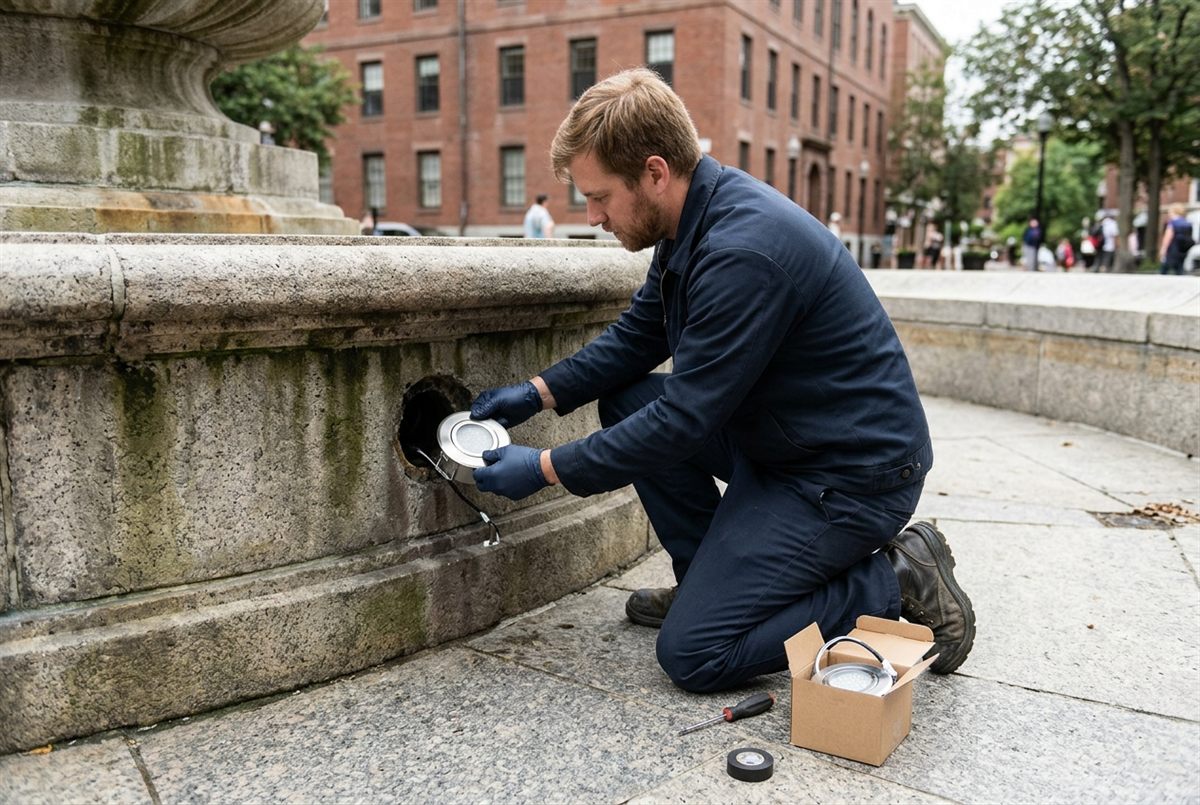
| Repair, Thu Aug 13 | LED niche fixture $890, lens gasket kit $46, cord seal $24. Labor 4.0 h |
| Restart and test, Aug 13 | GFCI holds for 30 minutes, all lights and jets on; water chemistry reading logged |
| After photos, Aug 13 | Light 3 lit, junction box sealed, fountain running |
| Date the repair was finished | Aug 13, 2026: the one-year warranty starts |
| Cause of the fault | Rain got in through a cracked lens gasket after the storm on Sat Aug 8 |
| Follow-up | Moisture behind light 2’s lens; estimate sent Aug 14; the operations manager follows it up by Aug 21 |
| Client’s confirmation, Fri Aug 14 | The city’s contact confirms by email that the jets and lights are running |
| Invoice, Aug 14 | Labor 6.0 h × $125 = $750; materials $1,104; total $1,854. Attached: request, estimate, approval, photos, hours, parts, date the repair was finished, purchase order number |
Why the date the repair was finished and the cause of the fault matter for the warranty
Each line of the fountain service report answers a question the city can ask. Who asked for the visit? The request email. Who agreed to the cost? The approval, dated before the repair. Does the fixture work? The 30-minute test and the after photos say so. So the invoice arrives with its documentation, and the city’s 60 days to pay can start.
Two lines matter long after payment, though. First, the date the repair was finished starts the one-year warranty in this city’s contract. If the new fixture fails in June 2027, the city can ask for warranty service, and that service must start within 10 business days of the city’s written notice.
Second, the cause decides who pays for the next visit. The warranty “does not cover damage due to misuse, neglect, vandalism, or weather-related incidents”. That is why a recorded cause, with photos, lets both sides judge a later failure on the facts. Without it, the argument starts from memory.
A second buyer that checks a signed tag instead
Another public buyer asks for different evidence. A US county set its terms for the fountain at its courthouse in solicitation 23-751, Exhibit A, “Water Fountain Maintenance”. This is one county’s request for quotes, so again these are one buyer’s terms and not a rule for anyone else.
Unlike the city, the county sets a response time: “Service calls shall take place within twelve (12) hours of the notification.” That is a time to respond, not a time to finish the repair. The county’s estimates for lighting or repair work also include travel, equipment, bulbs and labor.
Here the evidence sits on the fountain itself. At each visit, the technician signs a tag and leaves it in the pump box. The tag gives the company, the technician, the date and the service performed. Payment comes “after the County has verified” that tag. However, the clause sits under maintenance services, and Exhibit A does not say whether it covers repair calls. Nor does Exhibit A set out a written approval step; the county’s acceptance terms sit in a separate exhibit.
So one buyer wants documents with the invoice, and the other checks a tag in the pump box. In both cases, the record of the visit is what earns the payment.
What the city’s contract leaves unsaid
The city’s terms leave five things unsaid. They set no response time for a callout, and they name no person who confirms that a repair is finished. Nothing covers an emergency where waiting for approval would cause damage. The only thing that marks out a major repair is the city’s right to seek other quotes above $5,000, and the first visit to assess a fault is not mentioned at all.
Agree the missing terms before the first callout
Terms differ from client to client, and your company remains responsible for its own work and for the terms it signs. So settle each of those five things in writing with the city’s contact before the first callout. Agree who confirms that a repair is finished, and how, and whether the hours spent assessing a fault can be billed. Also agree what your technician may do to make a fountain safe before approval arrives. A change to the scope itself needs “a writing signed by the parties”, under the city’s standard terms.
The moisture behind light 2, for example, stays on the record with a person responsible for it and a date, so it is not a loose end. The contract also carries two one-year renewal options, and when the city weighs the first, a fault that was followed until it was fixed reads very differently from one nobody chased.
The August callout itself ended the way this guide describes. The request, the dated approval, the 30-minute restart test and the photos went to the city with the $1,854 invoice, so the evidence travelled with the bill, and the city’s 60 days to pay started the day it arrived.
PROOF THAT GETS A REPAIR PAID
The record of a repair is still useful long after the invoice is paid.
In this example, the city’s 60 days to pay started once the approval, the restart test and the date the repair was finished arrived with the invoice. Cascalto was built to keep every client, site, water feature and visit on record, and to follow every fault from the first photo until it is fixed.
Sources and references
- City of Providence, Rhode Island, Board of Contract and Supply, “Invitation to Bid: Seasonal Maintenance of City Fountains (July 1, 2026 – June 30, 2027), with two one-year options for renewal”, MinuteTraq #51642, bids opened December 29, 2025. providenceri.gov
- Lake County, Florida, “Solicitation 23-751, Exhibit A – Scope of Work: Water Fountain Maintenance”, 2023. lakecountyfl.gov