
Glossary · fountain and water feature service
The words of the trade, in plain terms.
Fifty-two terms that fountain and water feature service companies use every week — the water features, the equipment in the pump vault, the water chemistry, the service visit and the two seasons — each explained in a sentence or two, and where Cascalto uses it.
Coming soon
Claim founding-customer accessContents
52 terms in five groupsA plaza fountain, in section
Where each part sits.
A display fountain is mostly hidden: under the water and the paving are the pipes, a surge tank and a pump vault. The numbers match the terms below.
52 terms shown
No term matches. Try a shorter word.
Water features
What the service company looks after, by type.
- Water feature
Any built feature that moves or holds water for how it looks or sounds: fountains, water walls, reflecting pools, cascades, splash pads. In Cascalto each one is its own record inside a client’s site, with its equipment, readings and history.
- Display fountain
A fountain built to be watched: jets, sprays and light playing in a basin on a plaza, in a courtyard or at a hotel entrance. It is judged by how it plays as much as by its water.
Also called architectural fountain, ornamental fountain
- Water wall
A vertical face of stone, glass or metal with a thin sheet of water running down it, often indoors in a lobby or atrium. The sheet is fed from a trough at the top; a little scale or debris there shows as a dry streak down the wall.
- Reflecting pool
A shallow basin of still water meant to mirror the sky and the buildings around it. Still water shows everything — leaves, algae, a dull surface, a change in level — and many reflecting pools spill over a precise edge into a surge tank.
- Cascade
Water stepping down over a series of ledges or weirs into a lower basin. Each edge has to be level and clean for the water to fall evenly across it.
- Dry-deck fountain
A fountain with its nozzles set flush in the paving: the water falls on the deck and drains through grates to a tank below, so people can walk across it — and the space stays usable when the jets are off.
Also called pedestrian fountain, plaza-level fountain
- Splash pad
A play area of ground sprays and spray features with no standing water, usually started by an activator — a bollard or floor pad people touch. Flow-through splash pads use fresh water once and send it to drain; recirculating ones collect, filter and treat it, which brings in water chemistry and records.
Also called spray pad, splash park, spray park, interactive fountain
- Floating fountain
A fountain that floats on a pond or lake: pump and nozzle in one unit, moored in place and powered from the shore. As well as making a display it aerates the water, and where winters freeze it is usually pulled out before the cold and put back in spring.
Also called aerating fountain, pond fountain
Parts and equipment
From the basin edge down to the pump vault.
- Basin
The vessel that holds a water feature’s water. Its finish — stone, tile or a dark coating — is where scale, stains and algae show first.
- Coping
The cap stones along the top of the basin wall, where people sit and lean. Coping collects stains and the white bloom of efflorescence as splashed water dries on it.
- Weir
The edge that water flows over, set level so the water leaves it in an even sheet. A weir that is dirty, scaled or out of level makes the sheet break, gap or run to one side.
Also called overflow edge; a knife edge is a sharp weir with no visible coping
- Surge tank
A tank, often below ground, that takes the water spilling over a weir or draining from a dry deck, so the pumps always have water to draw from and the basin holds its level.
Also called balance tank
- Pump vault
The below-grade room or chamber that houses the pumps, filters, valves and controls, usually reached through a hatch in the paving. Much of a service visit happens down here.
Also called equipment vault, plant room
- Display pump and filtration pump
The display pump drives the nozzles and sets how high and how evenly the jets play. The filtration pump circulates the water through the filter and treatment equipment, often on its own schedule and even when the display is off.
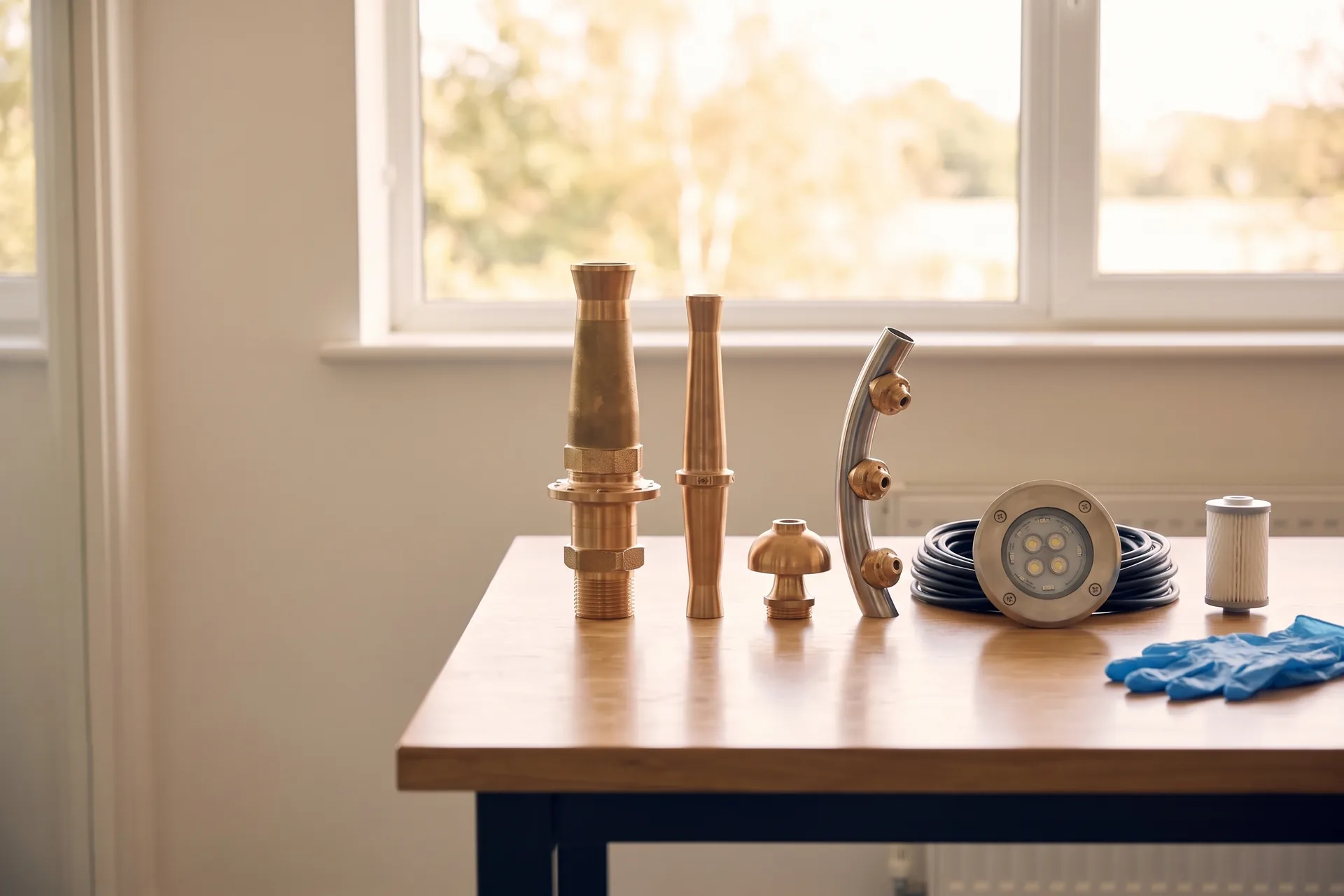
- Nozzle
The fitting that shapes the water as it leaves the pipe: a column, a spray, a bell or a smooth arc. A scaled or blocked nozzle is the most common reason one jet plays lower or more ragged than the rest.
Also called jet; a set of nozzles on one pipe is a nozzle ring or array
- Aerated jet
A nozzle that draws air into the water so the column looks white and full. Many aerated nozzles depend on the water level around them, so a low basin changes how they play.
Also called foam jet
- Smooth-bore jet
A nozzle that throws a clear, solid stream, used for tall single jets and arcs.
- Laminar jet
A nozzle that makes a glass-smooth, unbroken arc of water, often lit so the light travels inside the stream. It needs clean, steady water to stay smooth.
- LED fixture
A sealed underwater light, set in a niche or on a bracket below a jet. Lenses scale and seals age; a dark or dim fixture is one of the first things a client notices after sunset.
- Controller
The control panel that runs the water feature: pump schedules, show sequences, lighting, and the signals from sensors such as the wind sensor and the water level.
- Wind sensor
A sensor on a mast that tells the controller when the wind picks up, so the jets drop or stop before spray blows across paths, seating and doorways.
Also called anemometer
- Autofill
A level sensor and valve that top up the water lost to evaporation and splash-out. A sudden rise in the water it adds is often the first sign of a leak.
Also called make-up water, level control
- Low-water cutoff
A level switch that stops the pumps if the water falls too low, so they never run dry.
- Sand filter
A tank of filter media — sand or a substitute — that traps dirt as the water passes through it. When the pressure across it climbs, it is backwashed.
- Backwash
Running water backwards through a filter to flush the trapped dirt to waste, then setting it back to normal flow.
- Chemical feeder
The equipment that doses sanitiser or other treatment into the circulating water, so the chemistry holds between service visits.
- Pond aerator
Equipment that adds oxygen to a pond or lake by moving its water — a floating fountain, a surface aerator or a bottom diffuser — so it doesn’t go stagnant.
- Diffused aeration
Aeration from the bottom up: a compressor on the shore pushes air through lines to diffusers on the pond floor, and the rising bubbles turn the whole water column over. Nothing shows at the surface but the bubbles.
Also called bottom aeration
Water chemistry
What is tested, and why it shows.
- Water chemistry log
The record of every reading taken on a water feature, visit by visit, with what was added and any action taken. In Cascalto there is one for each water feature.
- Range
The band a reading should sit in for one particular water feature, set by you for that feature. Cascalto is built to flag a reading outside it and ask what action was taken.
- pH
How acidic or alkaline the water is. It decides how well the sanitiser works, and whether the water leaves scale or eats into stone and metal.
- Free chlorine
The chlorine still available to sanitise the water — the part of the dose not yet used up.
- Total alkalinity
The water’s ability to resist changes in pH. When it is low, pH swings; when it is high, pH is hard to move.
- TDS
Everything dissolved in the water. Evaporation takes water away but leaves its minerals behind, so TDS climbs over a season; the usual answer is to drain part of the water and refill.
Also called total dissolved solids
- Turbidity
How cloudy the water is, measured as the light scattered by particles in it. On a reflecting pool or a laminar jet it can be seen from across the plaza.
- Scale
Hard mineral deposits, mostly calcium carbonate, that build up on nozzles, lenses, weirs and stone. Scale narrows nozzles and is a common cause of low or uneven jets.
- Biofilm
A slimy layer of bacteria that grows on wet surfaces and inside pipework and shields them from disinfectant. Regular cleaning and sanitising keep it down.
- Efflorescence
A white, powdery bloom of salts left on stone and concrete as water evaporates from it — common on coping and along the dry edges of water walls.
- Legionella
Bacteria that grow in warm, still or slow-moving water and in biofilm, and can cause Legionnaires’ disease when people breathe in contaminated droplets. Because fountains and water walls create spray and mist, public-health guidance — such as the CDC’s toolkit for decorative fountains — treats them as features to watch: keep the water moving, manage temperature and disinfectant, clean out biofilm, and keep records. Many buildings include their fountains in a water management program. Cascalto is built to keep the visit records (readings, cleaning, faults) that such a program can draw on; the program itself stays the building owner’s responsibility.
Also called Legionnaires’ disease risk
Service visits and records
The work, and what is kept of it.
- Service visit
One visit to a site, with the work done on each of its water features: readings, the performance check, equipment checked, cleaning and photos.
- Performance check
A check of how the water feature plays against how it should: spray pattern, jet height, lighting and the sound of the pumps. Judged by eye and ear, and recorded with photos.
- Spray pattern
The shape the water makes as it plays — even, symmetrical and full. A pattern that leans, gaps or flutters usually points to a scaled nozzle, a level problem or the wind.
- Equipment at spec
Checking what a water feature should have in place — pumps, nozzles, lights, controls — against what is installed and working. An item missing or failed shows below spec.
Also called spec against actual
- Fault
Anything found not working as it should: equipment degraded or failed, a light out, a pattern off. It is recorded with a photo, the action taken — often a fountain repair — and the follow-up, until it is closed.
- Descaling
Removing scale from nozzles, lenses and weirs — usually by soaking or a mild acid clean — so jets and sheets play evenly again.
- Work Record
In Cascalto, the record of one job: each step as it was logged, before and after photos, the parts fitted and the time on site. It stays on the water feature’s history; the client sees it once you choose to send it — on request, or at will.
- Water Feature Report
In Cascalto, the report the client keeps: service visits, water chemistry against each water feature’s range, equipment status, faults and actions, the season’s protocol and photos, with a summary drafted for you to correct before it goes out.
The two seasons
Where winters freeze, the year turns on two cutovers.
- Spring commissioning
Bringing a water feature back into service after the winter: inspect and refit, fill, start the pumps, balance the water, set the jets, and test the lights, sensors and controls.
Also called start-up, opening
- Winterization
Shutting a water feature down for freezing weather: drain the basin and the lines, blow out the pipework, protect or remove the pumps, nozzles and lights, and close it up.
Also called shutdown, closing
- Blowing out the lines
Pushing compressed air through the pipework so no water is left in it to freeze and crack it.
- Drain-down and clean
Where fountains run all year: emptying the basin to remove scale, stains and sediment, service what is normally under water, and refill with fresh water.
- Protocol
A fixed checklist for a seasonal job, run step by step on every water feature. Cascalto is built to record each step with who did it and when.
Cascalto supports your water management program with documentation and records; it does not certify regulatory or Legionella compliance.
Keep reading
Where these words do their work.
- Every water feature on recordThe service visit feature by feature: water chemistry, the performance check, faults followed to closed, seasons by protocol, the Water Feature Report.See the records
- Water features at hotelsLobby water walls and courtyard cascades, serviced before breakfast and kept on record for the hotel’s engineering team.See hotel work
- Fountains on public plazasWind, litter, the occasional bottle of soap — and a property manager who wants to know what happened.See plaza work
Founding access
Be first when Cascalto opens.
Cascalto is being built for the companies that know these words by heart: every water feature on record with its equipment, water chemistry on every visit, seasons closed by protocol and a report your client can read. Founding-customer access and launch updates only.
Launching with a 14-day free trial. No card needed.
Coming soon
Claim founding-customer access